For decades, the textile industry followed a logic of speed. Produce faster, cheaper, and farther away. Synthetic materials progressively invaded wardrobes, interiors, and technical fabrics until they became the global standard. Yet behind this apparent modernity, a paradox emerged: the more industrially efficient textiles became, the further they moved away from nature itself.
Today, perspectives are changing.
Faced with environmental challenges, the limits of globalized production models, and a growing search for meaning in consumption habits, one material long considered traditional is returning to the spotlight: linen. This textile plant fiber, cultivated in Europe for centuries, is no longer valued solely for its authenticity. It now represents a new vision of textiles — more sustainable, more local, and more balanced.
The return of linen is not driven by nostalgia. It is a contemporary response to an industry searching for equilibrium.
When Plant Fibers Become a Source of Innovation Again
There is still a widespread misconception that natural fibers belong to the past while innovation must necessarily be synthetic. Current research, however, proves exactly the opposite.
Today, linen is increasingly used in high-performance sectors such as:
- composite materials;
- aerospace;
- automotive industries;
- high-level sports equipment;
- bio-based insulation;
- technical textiles.
This evolution is profoundly transforming the image of the plant fiber. Linen is no longer associated only with summer clothing or household textiles. It is becoming a strategic material capable of meeting modern industrial requirements.
Its mechanical resistance, lightweight structure, and thermal properties now attract industries far beyond traditional textile applications. Some manufacturers even see this textile plant fiber as a credible alternative to certain petroleum-based materials.
Nature is becoming technology again.
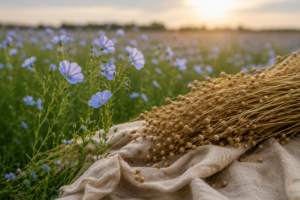
Linen Thread : A Material Carrying the Memory of Territories
Linen has a rare singularity within the contemporary textile world: it remains deeply connected to its territory of origin.
The plains of Northern France, Belgium, and the Netherlands still concentrate most of the world’s flax textile production. The oceanic climate, fertile soils, and local agricultural expertise make it possible to produce some of the highest-quality fibers in the world.
But behind every strand of linen thread, there is above all a complex human chain involving:
- farmers;
- scutchers;
- spinners;
- weavers;
- knitters;
- finishers.
This value chain creates a material with genuine geographical and cultural identity, standing in sharp contrast to standardized textiles produced anonymously on a global scale.
Linen thread therefore becomes more than a textile component. It embodies origin, craftsmanship, and European industrial continuity.
A Textile Plant Fiber That Almost Grows by Itself
One of linen’s greatest strengths lies in its natural sobriety.
Unlike some intensive textile crops, flax requires very little irrigation in the European regions where it is cultivated. Natural rainfall is generally sufficient to ensure its growth. The plant also requires limited chemical inputs and generates very little waste since nearly every part of it can be valorized.
Long fibers for textiles, tow, seeds, and shives all find industrial applications today.
This logic of complete plant utilization gives new meaning to the very notion of resource efficiency. While the modern textile industry has long operated according to a model of mass extraction, linen demonstrates that a material can remain highly performant without becoming excessively exploitative.
This textile plant fiber thus becomes a symbol of balance between agriculture, industry, and environmental responsibility.
The Return of Long-Term Thinking in the Textile Industry
The growing success of linen also reveals a deeper transformation in our relationship with textiles.
For years, clothing was increasingly designed as a disposable product. Today, consumers are looking instead for:
- durability;
- quality;
- reparability;
- traceability;
- natural materials.
Linen naturally responds to this cultural evolution. Its living appearance, its ability to develop character over time, and its durability all contribute to a different way of consuming textiles.
A linen garment does not age like a synthetic material. It evolves. It softens. It retains the memory of use.
This more lasting relationship with materials restores value to textiles themselves.
European Spinners Facing the New Challenges of Textiles
The renaissance of linen would not be possible without industrial actors capable of transforming this raw material into yarns adapted to modern market demands.
In this context, Safilin actively contributes to maintaining European expertise in linen and natural fiber spinning. Mastering the spinning process remains essential to guarantee the quality, consistency, and technical performance required by today’s textile markets.
Today, spinners are no longer simply producing a material. They are helping shape a new industrial vision where proximity, traceability, and quality once again become central values.
The development of European natural fibers is progressively transforming the entire textile chain.
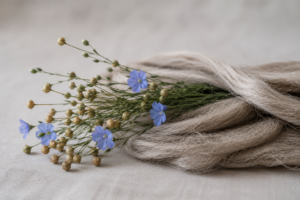
Textile Plant Fiber : Toward a New Culture of Materials
The return of linen goes far beyond environmental concerns alone. It reflects a deeper evolution in our relationship with materials, territories, and industrial production.
For years, the textile industry attempted to make the material itself invisible behind performance and mass production. Today, materials are becoming visible again. They are becoming a conscious choice.
Linen perfectly embodies this transition. Both ancestral and innovative, local and international, technical and natural, it may represent better than any other material the future of European textiles.
The rise of the textile plant fiber therefore marks the beginning of a new industrial culture: one capable of innovating without completely disconnecting from living systems.