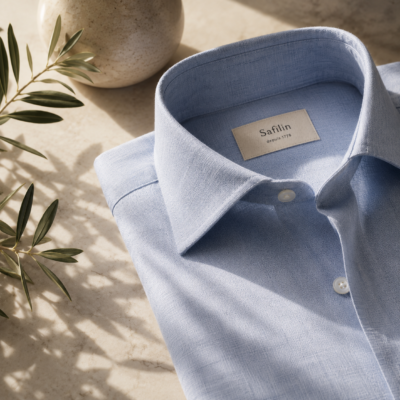
As summer approaches, one timeless wardrobe staple makes its return: the natural fibre shirt. Lightweight, breathable and elegant, the linen shirt has been appreciated for generations thanks to its exceptional comfort and effortless style.
Yet behind every beautiful fabric lies a series of technical choices that directly influence its appearance, hand feel, durability and overall performance.
For brands and fabric developers, selecting the right linen and hemp yarn is a critical step in creating a successful collection. Yarn count, weave structure, fabric density and ply construction all play an important role in determining the final characteristics of the fabric.
Today, thanks to advances in linen spinning and hemp spinning, designers have access to a wide range of solutions capable of producing everything from ultra-lightweight summer shirtings to more structured fabrics suitable for elegant evening wear.
Let’s explore how to select the right yarn and fabric construction to create a shirt that is both beautiful and comfortable.

Choosing the Right Weave Structure: The Foundation of Great Fabric
Before selecting a premium European yarn, it is essential to determine the fabric’s weave structure.
The weave defines how warp and weft yarns interlace. It directly influences drape, durability, breathability and the overall aesthetic of the finished shirt.
Plain Weave: The Benchmark for Linen Shirts
Plain weave is the simplest and most commonly used structure in linen fabrics.
Each weft yarn passes alternately over and under the warp yarns, creating a balanced and highly stable construction.
Advantages
- Excellent dimensional stability
- Outstanding mechanical strength
- Authentic and natural appearance
- Superior breathability
Drawbacks
- Slightly firmer hand feel
- More visible wrinkling
Combined with high-quality linen yarn, plain weave creates timeless summer shirts that perfectly showcase the beauty of European flax.
Twill: More Fluidity and Sophistication
Recognisable by its characteristic diagonal lines, twill weave reduces the number of interlacing points between yarns.
Advantages
- Softer drape
- Smoother hand feel
- More refined appearance
- Reduced wrinkling
Drawbacks
- More complex construction
- Slightly higher production costs
Twill is particularly appreciated in premium shirting collections that seek enhanced elegance and comfort.
Satin: The Ultimate Expression of Elegance
Satin weave allows yarns to float across the fabric surface, creating a luxurious appearance and touch.
Advantages
- Refined and sophisticated look
- Silky hand feel
- Excellent fluidity
Drawbacks
- Lower abrasion resistance
- More technical construction
When combined with fine linen and hemp yarns, satin weave produces elegant fabrics perfectly suited to luxury collections.
Understanding the Relationship Between Yarn Count and Fabric Density
In fabric development, yarn selection cannot be separated from fabric density.
Density refers to the number of warp and weft yarns present within a given area of fabric. It plays a major role in determining the final appearance and performance of the textile.
At an equivalent yarn count, a higher density will provide:
- More structure
- Better opacity
- Greater durability
- A denser hand feel
Conversely, a lower density will promote:
- Lightness
- Air circulation
- Freshness
- Fluidity
For lightweight summer shirts, fabrics generally range between 120 and 160 g/m².
For more sophisticated shirts designed for summer evenings, fabric weights often range between 180 and 220 g/m².
The balance between linen yarn, hemp yarn and fabric density is therefore one of the key elements in creating fabrics suited to specific end uses.
Which Linen Yarn Should You Choose for a Summer Shirt?
The metric yarn count (Nm) indicates the number of metres contained within one gram of fibre. The higher the number, the finer the yarn.
Nm 26 Linen Yarn: Authenticity and Character
Nm 26 linen yarn produces fabrics with strong visual presence and natural character.
It is particularly suitable for:
- Casual shirts
- Lightweight overshirts
- Textiles with an authentic aesthetic
Depending on fabric density, resulting fabrics generally range between 170 and 220 g/m².
For brands seeking to highlight European flax and natural materials, this yarn count is an excellent choice.
Nm 39 Linen Yarn: The Perfect Balance
Nm 39 linen yarn is often considered the benchmark for premium shirting.
It allows fabrics to be developed within the 130 to 180 g/m² range while maintaining an excellent balance between:
- Lightness
- Strength
- Breathability
- Elegance
Highly versatile, it performs exceptionally well in both plain weave and twill constructions.
Nm 50 Linen Yarn: Fineness and Freshness
Nm 50 linen yarn is designed for the lightest and most refined fabrics.
Its fineness makes it possible to develop airy textiles particularly appreciated during hot summer weather.
Fabric weights can drop below 130 g/m² while still maintaining the qualities expected from premium linen shirting.
Why Choose a Plied Yarn?
Plying consists of twisting two or more single yarns together to create a stronger and more stable yarn.
This process is frequently used in linen spinning when superior performance is required.
The Benefits of Plied Yarns
- Increased strength
- Better yarn regularity
- Reduced pilling
- Improved wash durability
- More premium appearance
For luxury shirting applications, plied yarns are often considered a mark of quality.
Hemp Yarn: The Ideal Fibre for Summer Evenings
Over the past few years, textile hemp has experienced a remarkable revival.
Advances in spinning technologies now make it possible to produce hemp yarns fine enough for high-quality apparel applications.
Hemp yarn offers several highly desirable properties:
- Exceptional strength
- Natural thermoregulation
- Excellent durability
- Elegant appearance
More structured than linen, hemp is particularly well suited to shirts intended for summer evenings.
Nm 15 Hemp Yarn: Structure and Elegance
Nm 15 hemp yarn allows relatively dense fabrics to be developed.
Fabric weights generally range between 180 and 250 g/m².
It is particularly suitable for:
- Casual chic shirts
- Summer overshirts
- Premium workwear-inspired garments
Its structured drape brings considerable character to the finished garment.
Nm 20 Hemp Yarn: Comfort and Refinement
Finer than Nm 15, Nm 20 hemp yarn allows softer and more fluid fabrics to be developed.
Typical fabric weights range between 150 and 200 g/m².
It represents an excellent alternative for brands seeking something different from traditional linen.
A shirt produced with Nm 20 hemp yarn offers:
- Excellent breathability
- High comfort levels
- Natural elegance
- Slightly more warmth than very lightweight linen fabrics
For long summer evenings, it is a particularly appealing option.
Linen and Hemp: Two Complementary Natural Fibres
Rather than viewing them as competitors, it is more accurate to see linen and hemp as complementary fibres.
Linen brings freshness, lightness and fluidity.
Hemp contributes structure, strength and durability.
Thanks to innovations across the European spinning industry, it is now possible to create fabrics for every application, from ultra-lightweight summer shirtings to more sophisticated fabrics designed to accompany elegant evenings by the sea.
Selecting the right linen and hemp yarn allows brands to unlock the full potential of Europe’s finest natural fibres.
Need Support Developing Your Next Shirting Fabric ?
Every textile project is unique.
Yarn count, weave structure, fabric density and finishing processes all directly influence the final performance of a fabric.
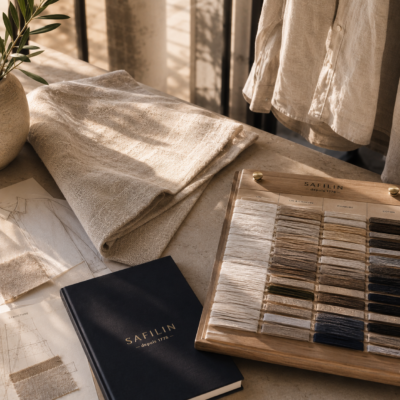
With centuries of expertise in linen spinning and the development of innovative hemp yarn ranges, Safilin supports brands, weavers and textile developers in creating tailor-made fabrics.
Our teams can help you select the right yarns, develop new constructions and optimise your fabrics to meet the precise requirements of your market.