
Welcome to the Safilin blog, the premier resource for linen enthusiasts. Today, we examine the various methods of flax spinning and the technical distinctions across modern production processes.
At Safilin, much of our work centers on yarns engineered through specialized wet and dry techniques. However, the global textile landscape encompasses additional manufacturing methodologies. As an industry benchmark, we provide this technical overview to illuminate these diverse approaches to flax spinning and their industrial applications.
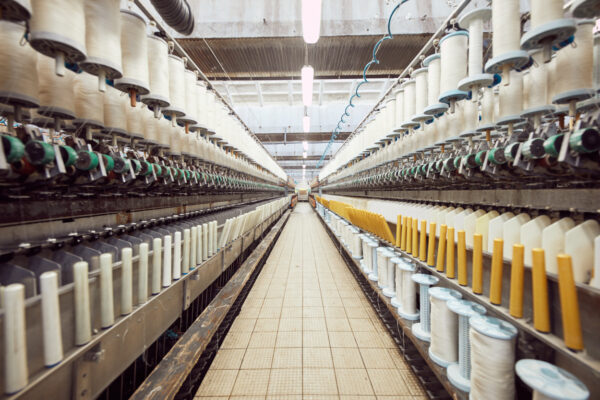
1. The Rationale Behind Multiple Flax Spinning Processes
Why develop distinct yarn manufacturing methods for a single natural fiber? A strictly volume-driven economic model might favor standardizing on a single protocol. However, technical performance, tactile hand, and visual aesthetics in textile engineering transcend pure productivity.
Different methods of flax spinning yield distinct yarn architectures, handle, and surface characteristics. While subtle on a bobbin, these structural variances become immediately evident once woven or knitted into finished fabrics.
2. Primary Spinning Techniques at Safilin
At Safilin, our manufacturing relies on two core variants of the traditional ring flax spinning framework:
-
Wet Spinning: Within this specialized variant of flax spinning, processing is conducted exclusively with long line fibers. This immersion-assisted ring process softens natural pectins, allowing optimal fiber division and alignment. It yields exceptionally smooth, uniform, high-tenacity yarns with a natural luster. These yarns serve premium apparel and home linen markets, while also meeting the rigorous technical demands of sheer drapery, luxury leather goods, and reinforced bio-composite materials.
-
Dry Spinning: Operating as an industrial dry flax spinning process, we run short fibers (scutching and combing tows) as well as long line fibers to produce coarser, highly characterful yarns. These yarns are primarily destined for upholstery, furnishing, and interior design (e.g., heavy drapery, sofa coverings). They also supply industrial sectors requiring durable cellulosic fibers, including food-grade butcher twine, horticultural trellising, agricultural cordage, and specialty rope making.
3. Alternative Flax Spinning Methods
Beyond the classic ring systems, specific industrial methods have evolved to address niche commercial segments:
- Open-End (Rotor) Spinning : Developed primarily to maximize throughput and operational efficiency, rotor-based flax spinning produces yarn at significantly higher delivery speeds. However, the resulting yarn exhibits lower tensile strength, a harsher hand, and a matte appearance compared to traditional wet or dry methods. Despite being thick, the yarn remains highly uniform and lacks the pronounced slub characteristic of natural linen. It displays slightly enhanced elongation, which can facilitate processing on medium-density weaving looms.
An untwisted sliver is fed into a high-speed opening roller covered with saw-tooth clothing that individualizes the fibers. An airstream transports these individualized fibers into a high-speed rotor. Centrifugal force collects the fibers in the rotor groove, and twist is inserted as the formed yarn is continuously drawn from the center.
- Compact Spinning : Developed with the opposite objective of open-end systems, compact flax spinning aims to maximize yarn uniformity and minimize hairiness. Through an aerodynamically perforated suction zone located directly after the drafting unit, fibers are condensed and parallelized before twist insertion. By virtually eliminating the spinning triangle and capturing edge fibers, this process yields an ultra-smooth, low-hairiness yarn with excellent performance on modern weaving looms.
While engineered as an advancement of the conventional ring system, compact methods remain relatively rare in industrial flax spinning. The commercial market typically values the subtle, naturally slubbed texture of linen rather than total uniformity. Furthermore, this method processes short fibers rather than the premium long line flax, which is reserved exclusively for wet spinning.
-
Self-Twist Spinning : Self-twist flax spinning generates alternating “S” and “Z” twist zones along the strand using reciprocating oscillating rollers. For two opposing strands to entangle and bind effectively at the convergence point, the raw material must possess high elasticity and flexibility (such as wool or acrylic fibers). Flax is inherently stiff, inelastic, and brittle; consequently, it resists self-twist insertion and tends to unravel at torque-reversal points. In practice, mills only utilize this method for intimate blends with more pliable carrier fibers to produce novelty yarns for decorative upholstery, restricted to lower-grade short tow fibers.

4. Safilin: Synthesizing Heritage and Technical Innovation
Safilin combines historical craftsmanship with contemporary industrial engineering. By maintaining and continuously refining our traditional wet and dry methods, we ensure our flax spinning operations adhere to rigorous international quality metrics.
We have optimized control parameters and increased throughput while preserving the structural integrity of natural bast fibers. Long line flax remains the noblest textile fiber, serving as the benchmark for demanding weavers and knitters worldwide. For authentic linen drape, strength, and aesthetic character, long line fiber processed through dedicated, high-precision flax spinning remains indispensable.
Thank you for reading.
Camille, Safilin
Academic and Technical References:
Lawrence, C. A.Advances in Yarn Spinning Technology. Woodhead Publishing.
Rieter Machine Works Ltd.Spinning Technologies and Fiber Preparation Handbooks.
NSC Fibre to Fabric (N. Schlumberger).Industrial Bast Fiber Processing and Drafting Manuals.