As the textile industry faces growing environmental challenges, brands and manufacturers are increasingly looking for solutions that combine transparency, quality, and sustainability. In this evolving market, linen is emerging as a leading eco-friendly textile material.
Primarily cultivated in Western Europe and processed close to the agricultural production areas, linen benefits from a unique value chain rooted in European expertise and regional know-how. This proximity between cultivation, spinning, weaving, and manufacturing naturally supports the development of short-supply-chain linen.
By reducing transportation distances and strengthening local production networks, the linen industry is becoming an important example of what a modern sustainable textile model can achieve.
A European Textile Fiber with Strong Territorial Roots
Linen occupies a unique place within the global textile industry. Nearly 80% of the world’s flax production is concentrated in France, Belgium, and the Netherlands. This historical concentration has enabled the development of a genuine European textile fiber industry supported by generations of agricultural and industrial expertise.
The regions of Northern France, Normandy, and Flanders offer ideal climatic conditions for flax cultivation. Thanks to these natural advantages, European flax fibers are recognized worldwide for their quality, durability, and technical performance.
Unlike many conventional textile materials transported across several continents before transformation, linen grown and processed in Europe benefits from a far more coherent and traceable supply chain.
Flax also offers several environmental advantages:
- very low irrigation requirements;
- limited use of chemical inputs;
- nearly complete valorization of the plant;
- lower environmental impact compared to many synthetic fibers.
These characteristics make linen one of the most relevant materials for the future of sustainable textile production.
Applying Short Supply Chains to the Textile Industry
Short supply chains are often associated with food production, but the concept is increasingly relevant within the textile sector. Short-supply-chain linen refers to the effort to keep the various stages of textile transformation geographically close to one another.
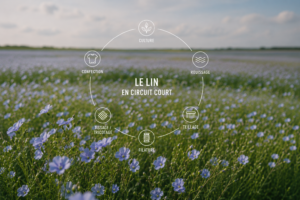
The linen value chain typically includes :
Flax Cultivation
Flax is mainly cultivated in Northern France and Belgium by highly specialized farmers with centuries of expertise.
Scutching and Fiber Preparation
After harvesting and retting, the flax fibers are separated from the plant during the scutching process. This essential stage prepares the fibers for spinning.
Spinning and Fabric Production
The fibers are transformed into yarns before being woven or knitted into fabrics for fashion, home textiles, technical fabrics, or composite materials.
Keeping these production stages within Europe offers several major advantages:
- reduced transportation emissions;
- improved traceability;
- preservation of industrial jobs and expertise;
- stronger supply chain resilience;
- greater transparency for brands and consumers.
This organization directly contributes to the production of an eco-responsible yarn adapted to modern sustainability expectations.
Building a More Sustainable Textile Industry in Europe
Over the past decades, a large share of textile production moved to Asia as companies sought lower manufacturing costs. However, environmental concerns, logistical disruptions, and changing consumer expectations are now encouraging brands to rethink their sourcing strategies.
In this context, Safilin contributes to maintaining European expertise in linen and hemp spinning through its industrial activities in Europe. By supporting local transformation capacities close to flax-growing regions, the company participates in strengthening a more coherent and responsible textile ecosystem.
The growing demand for traceable natural fibers is also encouraging closer collaboration between farmers, scutchers, spinners, weavers, and textile brands committed to more sustainable production models.
This renewed interest in natural fibers highlights the strategic importance of developing a resilient European textile industry built around European textile fiber production.
Linen : A Sustainable Textile Material for Modern Applications
Beyond its environmental benefits, linen also offers excellent technical properties. Naturally breathable, resistant, thermoregulating, and durable, flax fibers meet the requirements of many different industries.
Today, linen is used in:
- fashion and apparel;
- home textiles;
- upholstery fabrics;
- technical textiles;
- composite materials;
- automotive applications;
- sports equipment.
This versatility reinforces linen’s role as a high-performance eco-friendly textile material capable of supporting the transition toward a more sustainable textile industry.
Consumers are also increasingly attentive to the origin and manufacturing conditions of the products they purchase. The development of short-supply-chain linen directly answers these expectations by promoting transparency and regional production.
Short-Supply-Chain Linen : A Strategic Model for the Future
The rise of short-supply-chain linen goes far beyond a simple environmental trend. It reflects a broader transformation of the textile industry toward greater resilience, transparency, and local value creation.
By reinforcing regional supply chains and preserving industrial expertise, the linen industry contributes to building a more balanced and responsible textile economy in Europe.
Thanks to its low environmental impact, strong territorial roots, and technical performance, linen is increasingly recognized as one of the most promising fibers for the future of sustainable textile production.
As brands and consumers continue to prioritize traceability and environmental responsibility, European textile fiber production and eco-responsible yarn development are expected to play a growing role in shaping the future of the textile industry.