2026 flax harvest: record acreage confirms the momentum of European flax
In 2026, European textile flax is reaching a new milestone. According to the Economic Observatory of the Alliance for European Flax-Linen & Hemp, the combined spring and winter flax area is expected to represent at least 220,000 hectares in France, Belgium and the Netherlands, with around 2,000 additional hectares in the United Kingdom. The previous record, set in 2025, stood at approximately 200,000 hectares across the three main producing countries. Over ten years, the area devoted to flax has increased by 106%.
This historic figure must nevertheless be interpreted accurately: the 2026 record concerns cultivated acreage, not yet the final yield or fibre volume. The season began with favourable sowing conditions, but plant development, pulling and field retting remain closely dependent on the weather. With flax, a large cultivated area alone can never guarantee a large, high-quality harvest.
The increase does, however, reveal strong confidence in the fibre. Farmers, scutchers, spinners, weavers, knitters and brands are anticipating a lasting need for traceable natural materials. For Safilin, a historic European flax spinning mill, this momentum is an opportunity to recall that an eco-friendly fabric begins with a demanding raw material, a coherent value chain and carefully preserved expertise.
2026: a third consecutive acreage record
The trajectory is remarkable. In 2015, Western European flax acreage had not yet reached 100,000 hectares. It rose to almost 186,000 hectares in 2024 and then to 200,227 hectares in 2025 across France, Belgium and the Netherlands. For 2026, the Alliance estimates that it will exceed 220,000 hectares in the same production zone.
Winter flax is making a substantial contribution to this development. Between 55,000 and 60,000 hectares are thought to have been sown in autumn 2025 for the 2026 harvest, compared with approximately 30,000 hectares the previous winter. Spring flax was sown by mid-April in most growing regions, in initially favourable conditions. These figures reflect the industry’s determination to expand supply, while also spreading calendars and some agronomic risks.
Fibre availability is also improving thanks to the 2024 and 2025 harvests and increased scutching capacity. The Alliance reports that 19 new scutching lines have been installed in Western Europe within a decade, alongside the replacement of older equipment. In 2025, European long-fibre production reached a record 190,000 tonnes, while demand remained very dynamic, with an estimated 185,000 tonnes sold.
Why is Western Europe the world’s leading producer of flax fibre?
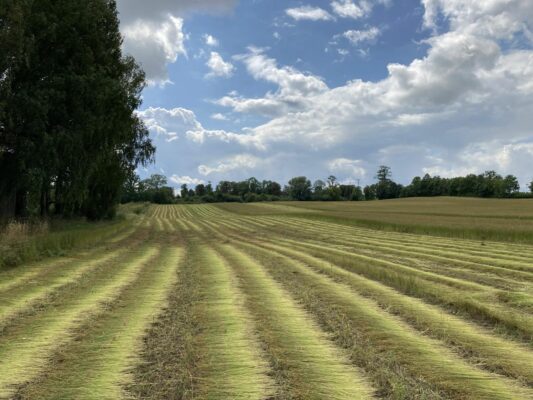
France, Belgium and the Netherlands produce around three quarters of the world’s long fibres, used mainly by the textile industry. This leading position does not rest on a single advantage, but on the rare combination of suitable land, climate and industrial organisation.
An oceanic climate ideally suited to flax
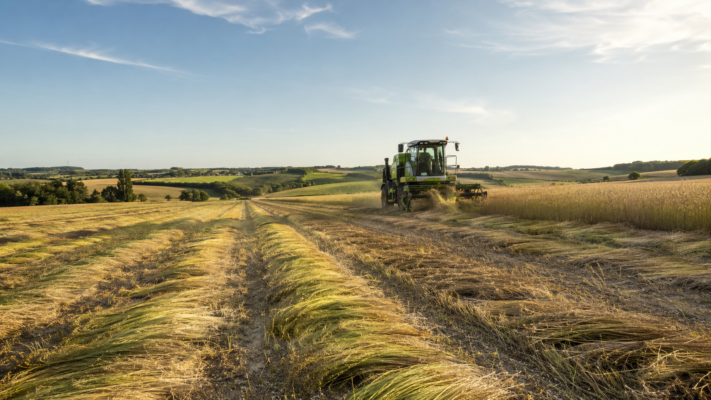
Flax thrives in moderate temperatures, regular humidity and alternating rain and sunshine. From Normandy and Hauts-de-France to Belgium and the Netherlands, the oceanic climate supports the plant’s rapid growth and the development of long, fine stems. After pulling, humidity also contributes to dew retting in the field: microorganisms gradually break down the natural substances that bind the fibre to the woody part of the stem.
Suitable soils and controlled crop rotations
The deep, fertile soils of the region, combined with detailed knowledge of individual plots, are well suited to this demanding crop. Flax returns to the same field only after several years. This rotation helps limit disease pressure and diversify farming systems. It also means that, as total acreage increases, the industry must continually identify additional suitable land.
An exceptional concentration of expertise
Sowing, pulling, turning, baling, scutching, hackling and spinning flax require specialised machinery and experience that few regions have retained on this scale. Western Europe benefits from a complete ecosystem: specialised growers, agricultural contractors, scutching mills, merchants, laboratories, flax spinning mills and textile manufacturers. This proximity accelerates knowledge sharing, improves traceability and makes it possible to tailor fibres to the requirements of fashion, home textiles, interiors and composites.
Why is flax cultivation intensifying ?
Strong demand after several difficult seasons
The Alliance had already attributed the 2024 acreage increase to two major factors: the sector’s intention to meet demand after four disappointing harvests and the attractiveness of returns for farmers. The 2020–2023 seasons had placed significant pressure on long-fibre availability. Larger cultivated areas now help rebuild a more resilient supply, secure stocks and support the growth of new and established applications.
An economically attractive crop that still carries risk
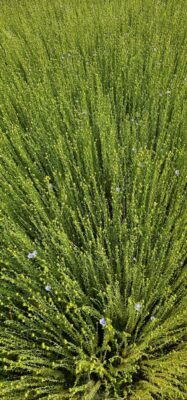
When fibre prices are supportive and contracts provide visibility, flax can become an attractive break crop for farms in established growing areas. In March 2026, the average price of Masters of FLAX FIBRE™ certified long fibres reached €5.89 per kilogram, up 7.7% in the first quarter. This level supports agricultural interest without turning flax into guaranteed income: yield, fineness, length, colour and homogeneity remain strongly influenced by each season’s growing and retting conditions.
The CAP: a supportive framework, not the sole explanation
The Common Agricultural Policy forms part of the broader context. EU flax growers are eligible for CAP direct payments, and Member States may, under certain conditions, grant additional support. Rules encouraging crop diversification, rotation and responsible agronomic practices can also make flax relevant to certain farms.
It would nevertheless be misleading to present the CAP as the main driver of the 2026 record. The Alliance’s market updates primarily highlight demand, grower remuneration, the rebuilding of supply and investment throughout the sector. The CAP supports the economic and agronomic environment; it does not remove the technical complexity of the crop or its exposure to weather.
Applications extending far beyond clothing
Linen remains sought after for garments, bed and table linen, sheers and furnishing fabrics. It is also gaining ground in technical textiles, panels, insulation and composites, where its low density and mechanical performance interest the mobility, design and sports-equipment sectors. The use of long fibres, tows, shives and seeds contributes to the economic balance of the entire plant.
Asia: a major industrial outlet within a global value chain
A significant share of European fibre is exported to Asia, particularly China, which remains a major centre for flax spinning, weaving and garment manufacturing. This processing capacity structurally supports demand for European long fibres. It also provides access to Asian markets where interest in natural materials, comfort and premium products is developing.
The picture must not be oversimplified: acreage growth is not driven solely by Asian consumption. Fibre may be transformed in Asia and then incorporated into products sold worldwide, including in Europe and North America. At the same time, rebuilding shorter European supply chains answers another need: processing more fibre close to where it is grown, with stronger traceability and more controlled logistics.
From record acreage to flax spinning: quality remains decisive
Between field and fabric, the fibre goes through numerous stages. Following retting and scutching, long fibres are hackled and blended before spinning. At Safilin, preparation involves combining different lots, growing areas and harvest years to achieve the most consistent possible quality and colour despite the natural variability of each crop. Wet spinning produces fine, regular yarns from hackled long fibres, while dry spinning notably makes use of tow to create yarns with a more authentic character.
This is where record acreage gains its full industrial significance. Greater availability creates more opportunities for fibre selection and blending, but it never replaces expertise. Yarn quality depends on the raw fibre, its preparation, machine settings, twist and final quality control. A flax spinning mill transforms the diversity of a living material into a consistent yarn suited to weaving and knitting requirements.
An eco-friendly fabric begins with a coherent value chain
Flax has compelling environmental attributes: it is renewable, predominantly grown without irrigation in its European production region, almost entirely valorised and processed through many mechanical operations. Yet an eco-friendly fabric cannot be defined by fibre alone. Origin, transport, energy used in spinning and weaving, finishing processes, product durability and end of life must be considered together.
The 2026 season therefore creates both an opportunity and a responsibility. More hectares can secure raw-material availability and serve growing markets. At the same time, the sector must preserve crop rotations, manage geographical expansion, maintain quality, adapt industrial capacity and promote traceable processing. For brands, choosing certified European yarn and working with partners able to explain every stage provides a concrete foundation for creating a credible eco-friendly fabric.
2026: a pivotal year for European flax
With at least 220,000 hectares announced across the three leading producer countries, 2026 sets a new record and confirms the vitality of European flax. Growth is supported by strong demand, greater economic appeal for farmers, industrial investment and an expanding range of applications. It also benefits from a European agricultural framework that encourages resilience and diversification, although the increase cannot be reduced to the CAP alone.
The true outcome will only be known after pulling, retting and the first scutching operations. With a natural fibre, quantity never fully predicts quality. It is precisely the role of the entire chain, through to the flax spinning mill, to reveal the potential of each harvest and transform it into regular, traceable and durable yarn. For Safilin, the record is not an end in itself: it is a further step towards a stronger, more transparent and more responsible European textile industry.
Suggested internal links
La préparation et la filature du lin Safilin
Textile écologique : comprendre une matière écologique textile
Les différentes utilisations du lin
Further reading
Alliance for European Flax-Linen & Hemp – Observatoire économique 2026
Alliance – Flax-Linen and Hemp Economic Observatory 2026 (English)
Commission européenne – Flax and the Common Agricultural Policy