At a time when the textile industry is facing significant environmental challenges, linen fabric stands out as the obvious choice : the most eco-friendly garment is often the one we keep for the longest.
Whilst recycling, bio-based fibres and new technologies feature prominently in the debate, durability remains one of the most effective ways to reduce a garment’s environmental impact. Choosing natural fibres known for their strength, such as linen or hemp, and prioritising careful craftsmanship helps to create garments designed to last. By extending their lifespan, we limit the need to replace clothes, reduce our consumption of resources and minimise textile waste.
Sustainability : the key criterion for responsible textiles
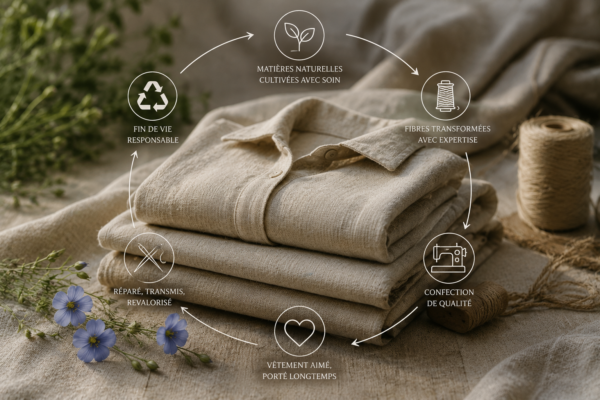
When we talk about eco-friendly fabric, we often think of its composition, origin or recyclability. However, one of the most decisive factors is its lifespan.
Every item of clothing requires resources to be manufactured: raw materials, energy, water, as well as processing, transport and manufacturing stages. The longer a garment is worn, the more its environmental impact is spread across a greater number of uses.
Conversely, regularly replacing low-quality garments leads to increased resource consumption and generates more waste. Making a garment last longer is therefore one of the simplest and most effective ways to reduce one’s environmental footprint.
Linen and hemp : fibres naturally designed to last
Certain fibres naturally possess properties that promote the longevity of textiles.
This is particularly true of linen and hemp, two plant-based fibres renowned for their excellent mechanical strength. Their structure enables them to withstand the stresses of everyday use whilst retaining their qualities over time.
Flax cultivation, which is widespread in Western Europe, benefits from a particularly favourable climate that naturally limits the need for irrigation. Combined with recognised industrial expertise, this enables the production of a high-performance, sustainable fibre.
Linen fibres offer numerous advantages :
- excellent tensile strength
- good dimensional stability
- low tendency to pill
- very good durability
These qualities explain why linen has been used for centuries in products subject to heavy use, such as household linen, furnishing textiles and certain items of clothing designed to last.
The quality of the yarn : the foundation of a sustainable textile
Even before a garment is made, it all begins with the quality of the yarn.
A consistent, uniform and strong yarn will result in a linen fabric that is stronger, more stable and more durable. Conversely, a yarn made from less carefully selected fibres or spun with less precision can lead to premature wear and tear of the fabric, a loss of strength or a less uniform appearance.
The spinner’s craft therefore plays a vital role in the final quality of a textile product.
At Safilin, durability begins with a rigorous selection of flax fibres. This raw material is then processed using a perfect mastery of spinning techniques, developed over several generations of expertise. This commitment results in yarns renowned for their consistency, fineness and strength, thus providing weavers and garment makers with a high-quality foundation for producing textiles designed to last.
Because a durable garment always begins with a high-quality yarn, every stage of the spinning process contributes directly to the longevity of the finished product.
A fine linen fabric deserves meticulous craftsmanship
Even the finest linen fabric will only reveal its full potential if it is combined with high-quality tailoring.
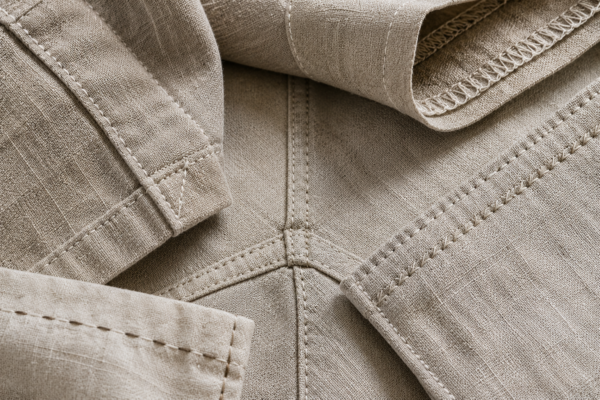
Seams are subjected to particular strain throughout the life of a garment. A meticulous finish helps to prevent tears, seams coming apart and premature wear and tear.
The lockstitch
The lockstitch is the most widely used stitch in high-quality garment manufacturing. It offers excellent resistance to stress whilst ensuring a neat and durable finish. In the event of repairs, it also has the advantage of being relatively easy to unpick.
The chain stitch
Widely used on jeans and workwear, the chain stitch provides greater flexibility. It follows the fabric’s movements whilst maintaining good strength, making it particularly suitable for areas subject to repeated stress.
The folded seam
Often found on high-end shirts or denim garments, the folded seam encloses the edges of the fabric. It improves the garment’s durability, minimises fraying and provides a neat finish on both sides.
Reinforcing topstitching
Pockets, shoulders, armholes and areas subject to heavy wear often benefit from additional topstitching, which distributes stress and significantly extends the garment’s lifespan.
A quality garment is one that can be mended
Sustainability does not depend solely on the technical characteristics of a textile. It also depends on the connection we have with the items we own.
When a garment is made from a beautiful linen fabric, is comfortable to wear and has been designed to last, we are naturally more inclined to have it repaired rather than replace it.
A sewn-on button, a mended seam or a repaired tear can often extend its lifespan by several years.
This practical value, as well as the sentimental value we attach to a high-quality garment, helps to reduce overconsumption of textiles and encourages a more responsible approach to fashion.
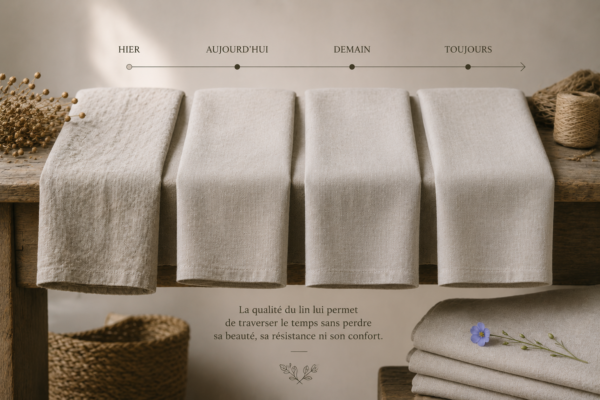
Linen stands the test of time
Linen’s reputation is based as much on its aesthetic qualities as on its remarkable durability.
A linen sofa cover can withstand many years of daily use whilst retaining its elegance.
A linen tea towel, often passed down from one generation to the next, becomes softer with every wash without losing its strength.
Linen sheets, tablecloths, towels and curtains also remain a feature of homes for decades when properly cared for.
This ability to age well makes linen a fabric particularly well-suited to products designed to last.
Choosing socially responsible businesses means supporting an entire sector
Buying sustainable clothing does not just benefit the wearer.
It also supports companies that invest in more responsible manufacturing processes, in the continuous improvement of their products, and in the development of solutions to reduce the environmental impact of the textile industry.
These investments cover everything from research into natural fibres to the optimisation of industrial processes, the reduction of energy consumption and the recovery of by-products.
By favouring committed businesses, consumers are part of a genuine virtuous circle. They encourage innovation, promote the development of products with a lower environmental impact and help to preserve recognised industrial expertise.
When these companies rely on European supply chains, they also contribute to the economic vitality of local areas and to the preservation of numerous local jobs, from flax cultivation through to spinning, weaving and garment manufacturing.
Buy less, but buy better
Building a more sustainable fashion industry is not just about choosing more environmentally friendly materials. Above all, it means prioritising garments designed to last for years.
The quality of the fibres, the expertise in spinning, the care taken in weaving, the tailoring and the finishing touches are all factors that determine the lifespan of a textile.
By choosing garments made from high-quality natural materials, such as linen or hemp, and manufactured to the highest standards, everyone can help reduce their environmental impact whilst supporting a forward-looking textile industry.
Because the most sustainable garment is often one made from linen, which we continue to wear year after year.